Recently, I joined our sales team at Viviane Health Technologies for direct outreach to healthcare facilities.
One conversation with the owner of a physiotherapy clinic stayed with me.
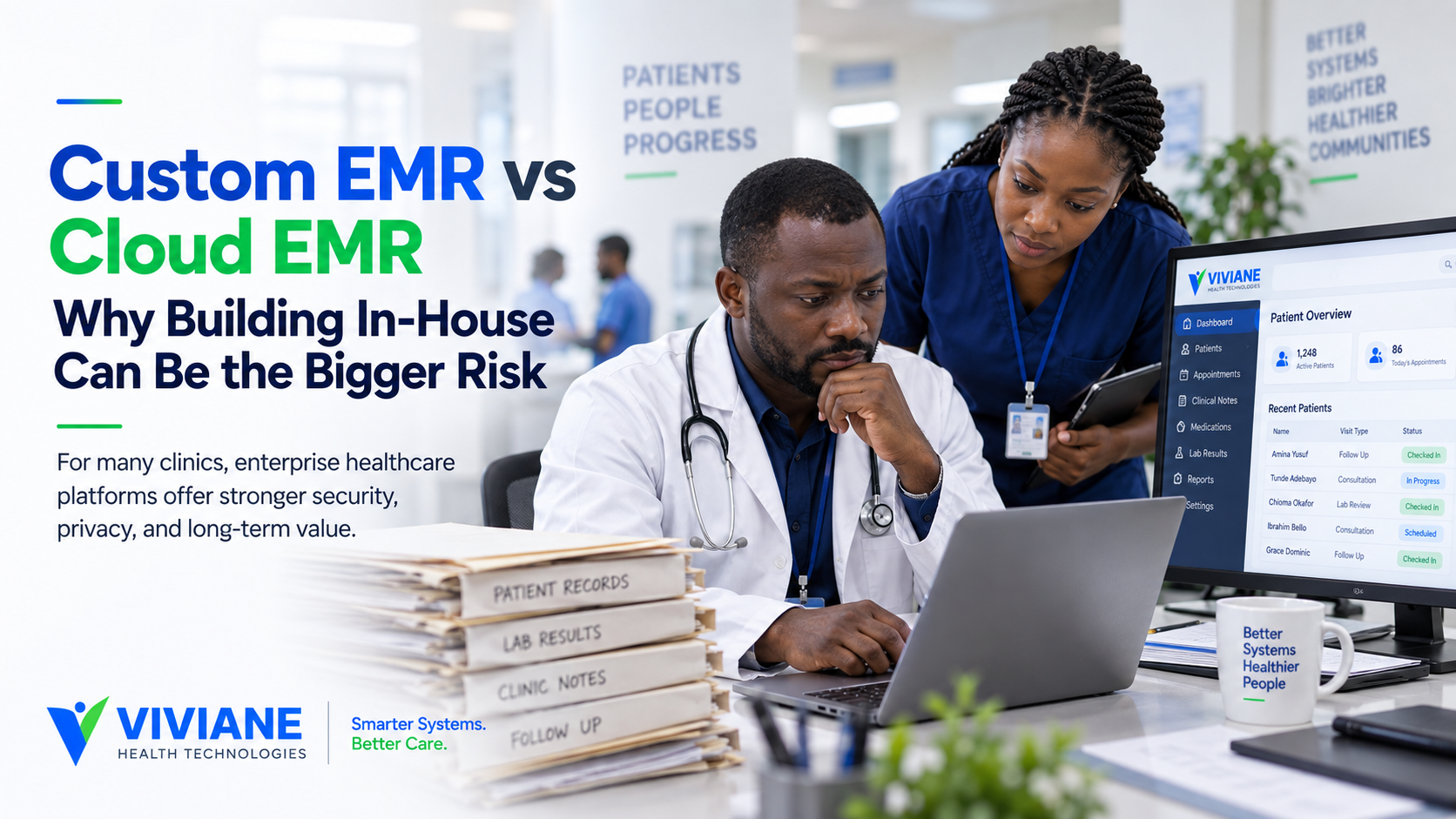
She told us she would rather build her own clinic management software than subscribe to an existing healthcare platform.
Her concern was understandable: security and patient privacy.
She believed that owning the software herself would give her greater control over her patients' information.
But that raises an important question for healthcare providers:
Does building your own EMR actually make patient data safer?
For most hospitals and clinics — particularly small and medium-sized facilities across Nigeria and Africa — I would argue that the opposite is more likely.
A serious enterprise healthcare software provider is generally in a far stronger position to invest continuously in security, infrastructure, privacy, software engineering and compliance than an individual clinic attempting to recreate those capabilities internally.
The issue is not whether custom software can be secure.
Of course it can.
The issue is what it actually takes to build and maintain enterprise-grade healthcare software.
And that is where the economics quickly change.
When a hospital builds software, it quietly enters another industry
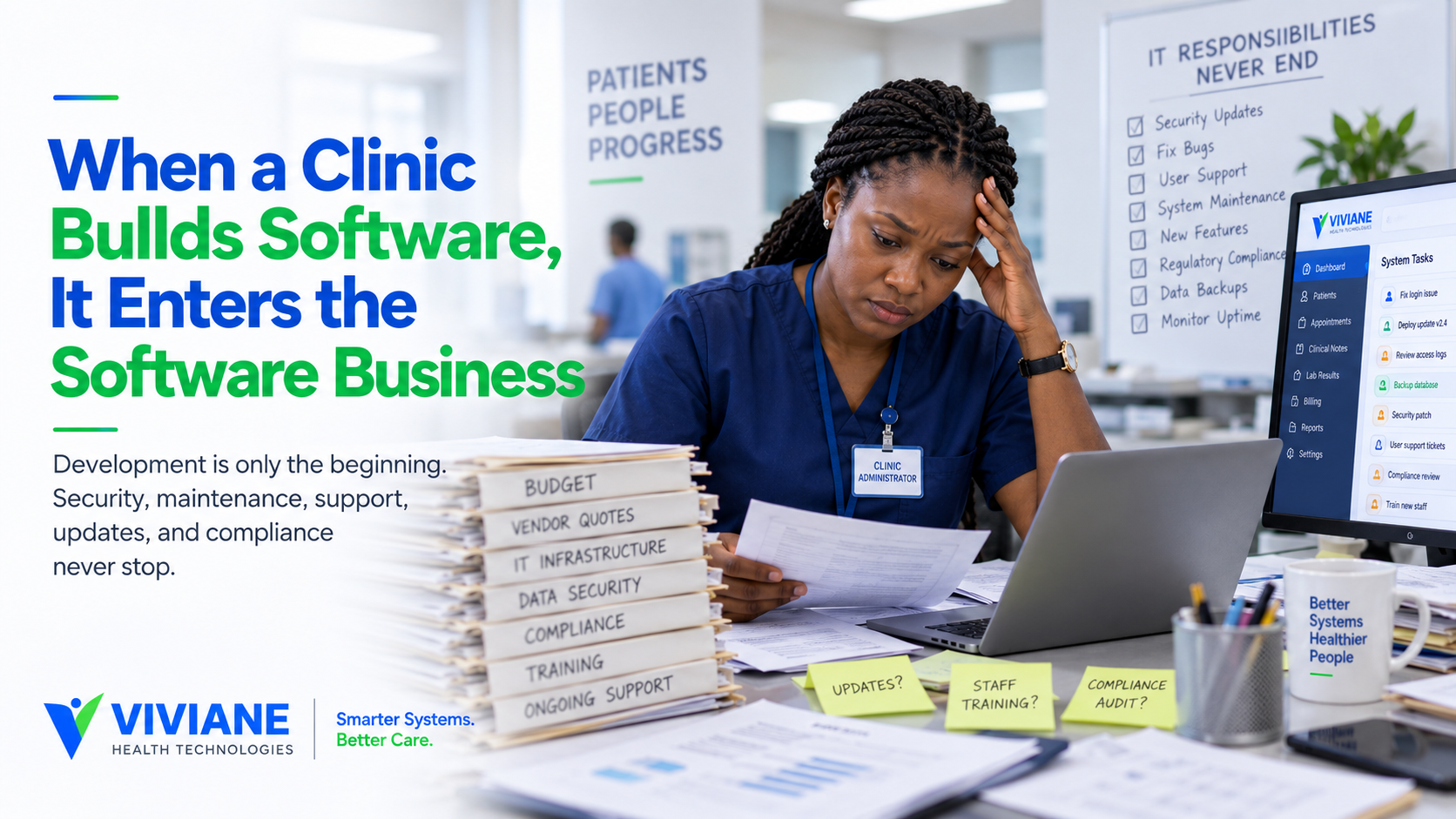 Suppose you operate a private hospital in Lagos, Abuja, Enugu, Accra or Nairobi.
Your organisation exists to deliver healthcare.
Then you decide to build your own Electronic Medical Record system because you want greater control.
At first, the plan might sound simple.
Hire a developer or software company. Explain your workflows. Build the application. Host it somewhere. Train your staff.
Done.
Except software does not work that way.
Launching the first version is only the beginning.
Someone still has to manage:
- authentication and permissions;
- database security;
- backups and disaster recovery;
- security updates;
- vulnerability management;
- server infrastructure;
- audit trails;
- application monitoring;
- incident response;
- regulatory requirements;
- integrations;
- testing;
- performance;
- new features;
- support;
- and the endless number of edge cases that emerge when real people start using software every day.
You have not simply purchased an EMR.
You have created a software product that must now be maintained for years.
That means your hospital or clinic has quietly entered the software business.
The economics rarely favour the average clinic
Enterprise software is expensive to build properly.
Not because writing code itself is unusually mysterious, but because serious software requires much more than developers.
That requires people who understand infrastructure, security, testing, deployments, failure recovery, healthcare data and long-term product maintenance.
For a large hospital group with a substantial technology budget, building proprietary systems may sometimes make strategic sense.
For the average Nigerian hospital, laboratory or physiotherapy clinic, however, recreating an enterprise healthcare platform internally can become an economic disaster.
The cost can begin competing with the amount of capital required to establish or expand the healthcare facility itself.
That money could have gone into medical equipment, additional branches, diagnostics, staffing, power infrastructure or working capital.
Instead, the organisation is financing a technology department.
This is precisely where enterprise software has an enormous advantage.
A company serving hundreds of healthcare facilities does not need one clinic to fund the entire engineering operation.
The cost of product development, infrastructure, security and support is spread across many customers.
A small clinic therefore gains access to technology it would struggle to justify building independently.
That is one of the fundamental economic advantages of subscription software.
One clinic knows one clinic. Enterprise platforms learn from an industry.
There is another advantage that is much harder to quantify.
Exposure.
Imagine that a hospital commissions a developer to build its own EMR.
The development team will naturally build around the workflows that hospital explains.
But what happens when something occurs that nobody considered during development?
Healthcare software is full of such situations.
A patient may have multiple encounters.
A clinician may work across several branches.
A staff member may need temporary access to a department.
A laboratory result may need correction after validation.
A payment may be reversed.
A prescription may need to interact with pharmacy inventory.
A user may accidentally modify clinical information.
A hospital may need to determine who viewed a patient's record months earlier.
A facility may suddenly open another branch.
These are not unusual events once software is deployed at scale.
An enterprise healthcare provider serving different hospitals, laboratories, pharmacies and clinics encounters an enormous variety of workflows.
Implementations, support requests, unusual workflows and security reviews continuously expose the product team to new edge cases and force the platform to mature.
A single facility cannot easily reproduce that learning environment.
Its custom software is largely shaped by the problems that the facility already knows about.
Enterprise software gradually becomes shaped by problems encountered across an entire industry.
That accumulated knowledge is one of the biggest differences between mature enterprise software and a custom application developed for one organisation.
A good developer is not automatically a healthcare software expert
Nigeria and the wider African technology ecosystem have excellent software engineers.
But software engineering itself is broad.
Being capable of building a banking dashboard, e-commerce platform or logistics application does not automatically mean a developer understands the requirements surrounding clinical software.
Healthcare introduces additional complexity.
You are dealing with sensitive medical information.
Different categories of employees require different levels of access.
Activities may need to be auditable.
Clinical data may need to move between systems.
There may be laboratory, pharmacy and radiology integrations.
There may be retention requirements.
There may be interoperability standards.
There are also data-protection obligations.
A hospital therefore has to ask more than:
"Can this developer build the application?"
It should also ask:
"Has this team built and operated serious healthcare infrastructure before?"
Those are very different questions.
The danger with bespoke software is that the first question is usually much easier to answer than the second.
A facility can pay significantly more for custom development and still end up with weaker security, poorer architecture and less regulatory awareness than it would receive from an established enterprise platform.
Paying more does not automatically produce enterprise-grade software.
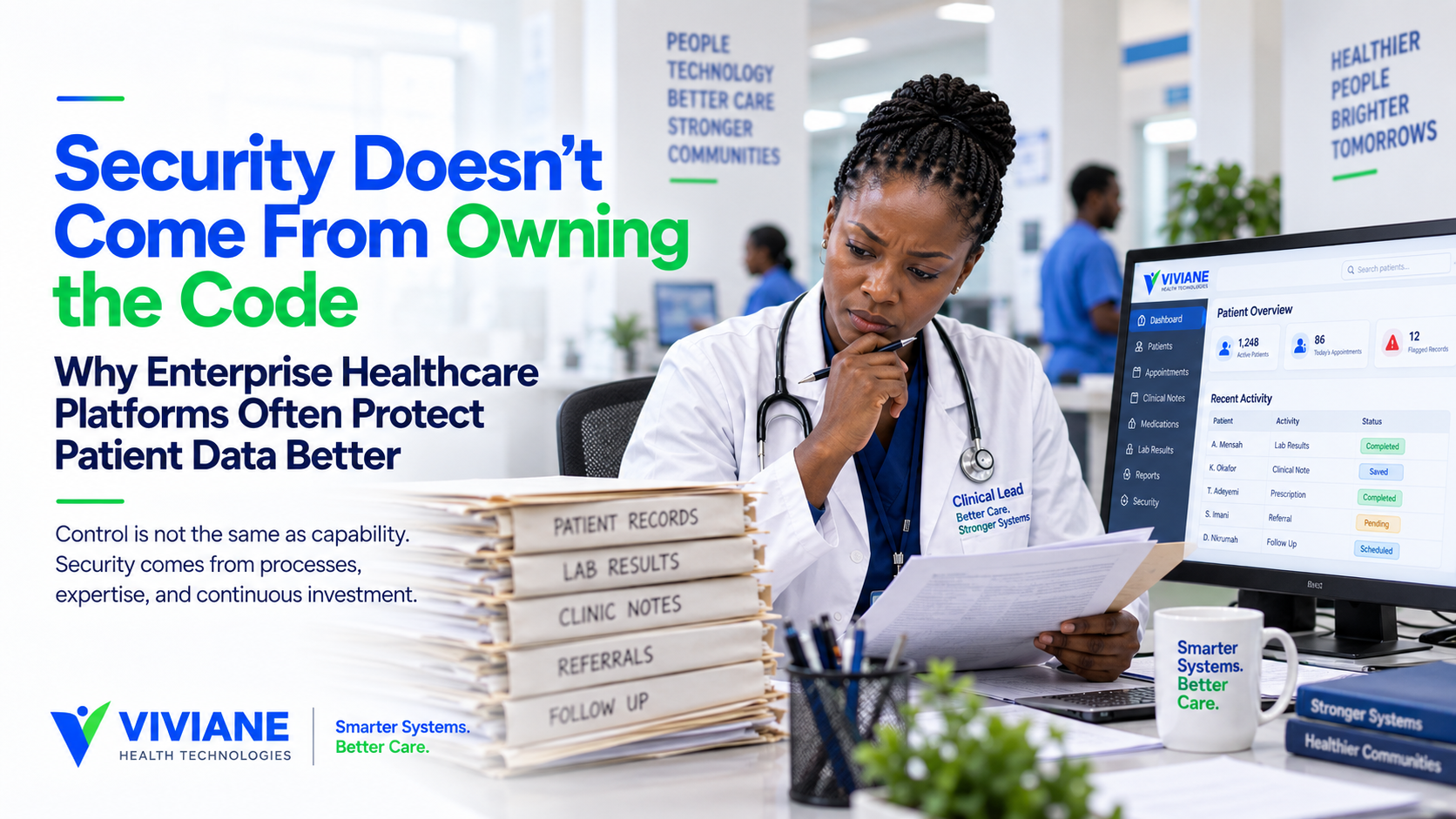
Security is not created by owning the source code
 There is a psychological comfort in saying:
"The software belongs to us, so our data is safer."
But ownership does not create security.
Owning the source code does not create strong access controls.
Hosting a server inside your building does not create disaster recovery.
Hiring one developer does not create security monitoring.
Knowing where your database is located does not mean it has been properly secured.
Security is created through processes and engineering discipline.
It comes from well-designed permissions, encryption, backups, audit trails, monitoring, code review, vulnerability management and incident response.
And most importantly, doing all of these things continuously.
Security is not a feature that developers add before launching an application.
It is an ongoing organisational capability.
That is why serious enterprise providers invest continuously in it.
Enterprise healthcare providers also carry responsibility for patient privacy
Healthcare facilities understandably worry about allowing another company to process their patients' information.
But using an enterprise platform does not mean privacy responsibility disappears.
Quite the opposite.
A hospital owes obligations to its patients.
A serious enterprise software provider handling information for that hospital also assumes legal, contractual and professional responsibilities.
In Nigeria, health information is treated as sensitive personal data under the country's data-protection framework.
That means companies processing healthcare information cannot simply treat patient records like ordinary application data.
For a healthcare technology provider such as Viviane Health Technologies, protecting customer and patient information is therefore not simply a product feature.
It is part of the responsibility that comes with operating healthcare infrastructure.
There is also an important commercial reality.
If a small clinic's internal application suffers a serious security incident, that facility has a major problem.
If an enterprise healthcare software provider repeatedly fails to protect customer information, the provider can lose customers, contracts, reputation and ultimately its business.
Our incentives are therefore directly connected to maintaining trust.
Security and privacy are not side concerns.
They are existential concerns.
And then the clinic needs more than an EMR
There is another problem with the custom-software approach.
Healthcare facilities rarely need only one application.
After building the EMR, someone eventually asks for inventory, pharmacy, laboratory, radiology, human resources, billing, procurement, telemedicine, online booking, a patient portal, electronic prescriptions, analytics and integrations.
Increasingly, facilities will also want clinical AI and automation.
At that point, the organisation is no longer maintaining one custom application.
It is attempting to build a healthcare technology ecosystem.
And every new application creates another integration challenge.
If the laboratory is separate from the EMR, how do results automatically appear in the patient's record?
If pharmacy is separate from inventory, how does dispensing medication update available stock?
If billing is separate from clinical workflows, how are services automatically charged?
If telemedicine exists separately, where does the resulting consultation record go?
If the organisation operates several branches, how does management obtain one reliable view of operations?
Enterprise healthcare companies solve these problems repeatedly because integration is part of the product itself.
At Viviane Health Technologies, for example, our broader healthcare ecosystem includes electronic medical records, laboratory systems, radiology, pharmacy, inventory and ERP, telemedicine, patient-facing platforms and other connected healthcare workflows.
A facility subscribing to such an ecosystem does not have to independently finance the development of every new component it will eventually require.
The platform grows while the healthcare provider remains focused on healthcare.
Enterprise platforms can offer something internal software cannot: network value
Traditional custom software normally serves one organisation.
It manages the patients the facility already has.
But healthcare platforms can create value outside the walls of the facility.
For example, Viviane Health's patient-facing ecosystem can create additional ways for patients to discover participating healthcare facilities and interact with healthcare providers.
That changes the software conversation.
Technology is no longer merely an administrative expense.
It can become part of a facility's patient-acquisition, service-delivery and growth infrastructure.
A custom application built solely for internal use has a difficult time reproducing that network effect.
African healthcare does not need thousands of hospitals reinventing the same software
This is where the conversation becomes bigger than one clinic.
Africa has thousands of healthcare facilities trying to modernise.
Many operate with limited capital.
They already deal with infrastructure challenges, workforce shortages and expensive medical equipment.
It makes little economic sense for every small hospital, clinic, laboratory and pharmacy to independently reinvent authentication, electronic medical records, billing, inventory, pharmacy systems, laboratory software and security infrastructure.
Imagine if every clinic decided that because electricity was important, it should manufacture its own generators.
Or because medical imaging was sensitive, every hospital should manufacture its own CT scanner.
We understand instinctively why specialisation makes sense in those industries.
Software should not be treated differently.
Africa needs healthcare technology companies whose entire job is to build secure, reliable and locally appropriate healthcare infrastructure.
At scale, improvements, integrations and hard-won lessons can be shared across the network, making sophisticated technology more accessible without asking every clinic to finance its own software company.
Before building your own EMR, ask one question
Healthcare providers considering bespoke software should certainly evaluate security, privacy and control.
But they should also calculate what genuine control actually costs.
Who owns security, backups and incident response?
Who maintains the system when the original developers leave?
Who keeps up with healthcare regulation and integrations?
Who supports users and improves the product over time?
And when the facility needs laboratory software, pharmacy, inventory, telemedicine, analytics or AI, who builds and connects it all?
If answering those questions requires creating an internal engineering, infrastructure, security and product organisation, then the real decision is no longer simply:
"Should we build our own EMR?"
The real question is:
"Does our healthcare facility also want to become a software company?"
For most small and medium-sized healthcare providers, that is probably not where their scarce capital, leadership attention and operational energy should go.
Healthcare providers should concentrate on delivering healthcare.
Technology companies should concentrate on building the infrastructure that helps them do it better.
That specialisation is one of the reasons enterprise healthcare platforms exist in the first place.
Evaluating healthcare software for your facility?
Viviane Health Technologies builds connected digital infrastructure for hospitals, laboratories, physiotherapy clinics, pharmacies and other healthcare providers.
Facilities can adopt clinical records, diagnostics, inventory, operations, telemedicine and patient-facing services on one evolving platform instead of financing each capability from scratch. If you are weighing custom development against an enterprise platform, evaluate the full cost of security, maintenance, integrations and future growth — not just the first build.