Introduction
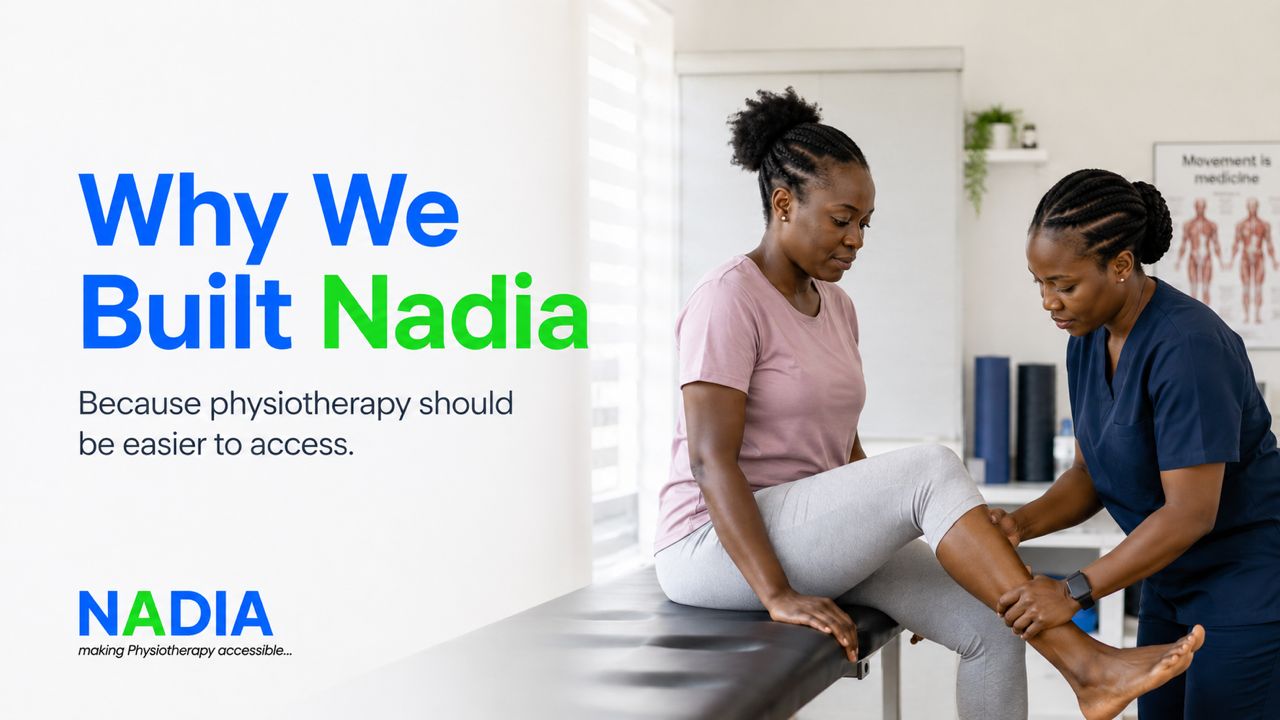
Understanding why we built Nadia cannot be separated from the story behind Viviane Health Technologies itself.
Everything started with Ikechukwu Vincent Unegbu’s health crisis while studying at the University of Nigeria, Nsukka. Living with chronic physical conditions that required long-term physiotherapy gave him firsthand experience of the realities physiotherapy patients face in Nigeria.
Over time, he realised that whenever he moved from one city to another, finding reliable physiotherapy services was often difficult. Discovering qualified physiotherapists, identifying nearby clinics, verifying credibility, and maintaining continuity of care across different locations could become stressful for patients already dealing with pain, mobility limitations, or long-term recovery.
On deeper research, another major issue became obvious: there is a significant shortage of physiotherapists in Nigeria relative to the number of people who require rehabilitation and physical recovery support.
This shortage affects not only patients recovering from injuries and surgeries, but also people living with chronic pain, spinal conditions, stroke recovery, neurological disorders, mobility limitations, musculoskeletal conditions, sports injuries, and other long-term physical challenges.
Being a patient dependent on physiotherapy for years also exposed Ikechukwu to another important reality: recovery itself does not happen only inside the clinic.
Most physiotherapy patients spend far more time outside the clinic than inside it. The actual healing process often depends on consistency, guided exercises, rehabilitation discipline, posture correction, education, follow-up care, and long-term support between appointments.
Processing these realities, it became clear that there was a need not only for better service discovery and digitisation, but also for technology that could actively support patients throughout their recovery journey.
This thinking became the foundation behind Nadia.
Why Existing Solutions Were Not Enough
Most healthcare software systems were not designed specifically for physiotherapy workflows and rehabilitation care.
Many generic hospital systems treated physiotherapy as just another department rather than recognising that rehabilitation care is highly continuous, progress-driven, and patient-engagement dependent. Physiotherapists often had to rely on fragmented tools for appointments, patient notes, exercise tracking, communication, teleconsultations, and operational management.
We also observed that many physiotherapy practices, especially independent practitioners and smaller clinics, still relied heavily on paper records, manual scheduling, WhatsApp communication, and disconnected operational workflows.
Beyond clinic operations, we realised that most existing digital solutions focused primarily on administration and record keeping while paying little attention to the actual recovery experience of patients themselves.
However, rehabilitation is not simply about documentation. Recovery often requires continuous guidance, exercise adherence, monitoring, education, encouragement, and long-term engagement outside physical consultations.
Another major challenge was accessibility. Due to the shortage of physiotherapists and uneven distribution of specialists, many patients struggle to consistently access quality physiotherapy services, especially outside major cities.
These observations shaped our thinking significantly.
We believed physiotherapy technology needed to evolve beyond clinic management software into connected rehabilitation infrastructure designed around both practitioners and patients.
The Vision
The vision behind Nadia is to build a comprehensive physiotherapy and rehabilitation platform designed around continuity of recovery, accessibility of care, and better rehabilitation experiences for both physiotherapists and patients.
In pursuit of this vision, Nadia combines Physiotherapy Clinic Management, EMR capabilities, tele-physiotherapy infrastructure, patient engagement systems, recovery tracking, digital rehabilitation support, and intelligent patient assistance into a unified platform.
However, our vision extends beyond simply digitising physiotherapy clinics.
More importantly, recovery itself should become more connected, guided, and accessible.
A patient’s rehabilitation journey should not feel isolated between appointments or dependent solely on occasional physical visits. Patients should have access to continuous support, structured recovery guidance, educational resources, progress tracking, and easier communication with care providers throughout the healing process.
This is why Nadia was also designed as a patient recovery assistant platform.
Through intelligent and personalised digital assistance, Nadia helps support patients during rehabilitation by assisting with exercise guidance, reminders, follow-up support, recovery education, patient engagement, and continuity throughout long-term treatment journeys.
Tele-physiotherapy also plays an important role in this vision.
We believe physiotherapy care should not be limited strictly by geography or physical clinic access. Through remote consultations and digital rehabilitation support, physiotherapists can extend care beyond clinic walls and support patients more consistently regardless of location.
This long-term vision is what continues to shape what we are building toward.
Our Philosophy
Being built from firsthand patient experience alongside healthcare infrastructure expertise, Nadia’s philosophy has naturally been shaped by rehabilitation realities and long-term recovery challenges.
At Nadia, our philosophy is simple:
Recovery is a continuous journey
Patients need support beyond appointments
Technology should reduce recovery stress, not increase it
Accessibility to care matters
Healthcare workflows should remain simple and practical
Digital systems should support both practitioners and patients
Continuity of care should remain central to rehabilitation
Infrastructure should be built for long-term reliability and scalability
Who We Built Nadia For
Nadia was built for physiotherapists, rehabilitation professionals, physiotherapy clinics, independent practitioners, and most importantly, patients navigating physical recovery journeys.
While many parts of Africa are still dealing with broader healthcare digitisation challenges, rehabilitation care remains even more underserved digitally.
Patients recovering from chronic pain, injuries, surgeries, neurological conditions, mobility disorders, sports injuries, and long-term physical conditions often require structured support over extended periods of time. Yet the systems supporting both patients and physiotherapists remain highly fragmented.
This is why Nadia was designed not simply as another clinic software product, but as a rehabilitation infrastructure built around the complete recovery journey.
Although we are starting from the African market, the long-term vision behind Nadia is global from day one.
What We Are Building Toward
At the core of Nadia’s vision is a connected rehabilitation journey.
Recovery today is often inconsistent and fragmented from the patient’s perspective. Patients may attend therapy sessions periodically but struggle with continuity, motivation, exercise adherence, progress tracking, and access to ongoing professional guidance outside appointments.
We believe rehabilitation infrastructure should work differently.
We envision a future where patients recovering from physical conditions can experience more guided, accessible, and continuous recovery support across consultations, home exercises, tele-rehabilitation, follow-up care, recovery monitoring, and practitioner communication.
A future where physiotherapists can manage patient recovery more efficiently while extending care beyond physical clinic limitations.
This vision goes beyond simply digitising physiotherapy records.
It is about building infrastructure that supports long-term healing and rehabilitation continuity.
We are building toward a rehabilitation ecosystem where:
patients can recover with better guidance and continuity,
Physiotherapists can manage rehabilitation more efficiently, Tele-physiotherapy becomes more accessible,
recovery tracking becomes more structured,
and rehabilitation data becomes more useful for long-term patient outcomes and clinical decision-making.
Artificial intelligence will also play an important role in this future, not as a replacement for physiotherapists, but as a support layer that enhances patient engagement, rehabilitation guidance, recovery monitoring, intelligent assistance, and operational efficiency.
Ultimately, what we are building toward is not just physiotherapy software, but connected rehabilitation infrastructure designed around the complete patient recovery journey.
Final Thoughts
At Nadia, we believe rehabilitation and physiotherapy care can become more connected, more accessible, more consistent, and more patient-centred.
We are building toward a future where physiotherapy clinics and rehabilitation professionals no longer have to rely on fragmented workflows and disconnected communication systems, while patients receive better continuity throughout their healing journey.
Physiotherapists and rehabilitation facilities that work with Nadia can expect:
simplified clinic and patient management,
digital physiotherapy documentation and EMR workflows,
tele-physiotherapy capabilities,
improved appointment and recovery tracking,
better patient engagement and follow-up systems,
AI-assisted rehabilitation support for patients,
reduced operational stress for practitioners,
improved continuity of care,
and infrastructure designed for long-term scalability and reliability.
Most importantly, we believe rehabilitation technology should support real recovery journeys and real physiotherapy workflows, not create additional complexity.
As we continue this journey, we would love to work with physiotherapists, rehabilitation specialists, physiotherapy clinics, healthcare professionals, and healthcare facility owners who share this vision for the future of rehabilitation care.
If you are interested in digitising, modernising, or improving rehabilitation and physiotherapy care delivery, we would be glad to connect.